
Executive Summary: Most organizations track capital expenditures down to the last dollar, yet ignore the massive payroll drain and morale erosion happening inside their own leadership meetings. When executive sessions devolve into polite status updates and passive "artificial harmony," companies pay a hidden operational tax—measured in wasted senior compensation, stalled decisions, and expensive rework after launch.
Every quarter, executive teams scrutinize operational budgets, software licenses, and vendor contracts to eliminate waste. Yet almost none of them audit the single most expensive line item on their weekly calendar: the leadership meeting.
Gather eight senior executives in a room for two hours, and you are easily looking at thousands of dollars in direct payroll time. That investment makes complete sense when the room is producing sharp, stress-tested strategic decisions.
It becomes a massive financial liability when the room defaults to polite status updates and passive consensus.
The data backs up what every exhausted leader already feels. Workplace research from Atlassian and Harvard Business Review over the past several years reveals that 72% of meetings are deemed ineffective at achieving their stated purpose, while 77% of unproductive meetings simply spawn more follow-up meetings. Worse, over 90% of professionals report suffering from a "meeting hangover"—a measurable drop in morale, mental energy, and focus that lingers long after a frustrating session ends. Conversely, when organizations eliminate bloated, unfocused syncs, HBR research shows productivity jumps by 71%.
In facilitation work, we call this The Meeting Tax—the hidden, compounding cost an organization pays whenever senior leaders spend hours in the same room without engaging in real, decision-driven dialogue.
The 3 Hidden Costs of the Meeting Tax
The Meeting Tax rarely shows up as a single line item on a balance sheet. Instead, it quietly erodes margins and team morale across three operational areas:
1. The "Status Update" Payroll Drain: When leadership meetings are used to recite progress reports that could have been shared in a five-minute written brief, you are paying executive-level rates for administrative recitation. High-value strategic thinking gets pushed out by routine reporting, leaving leaders mentally drained before real problem-solving even begins.
2. The "Meeting After the Meeting" Overhead: When artificial harmony prevents leaders from voicing real objections in the boardroom, the actual debate doesn't disappear—it simply moves offline. Executives spend hours in fragmented 1-on-1 calls, private Slack threads, and backchannel hallway conversations trying to decode what was actually decided.
3. The Rework Multiplier: A flaw caught during a facilitated boardroom debate costs nothing to fix. That exact same flaw caught six months into product rollout or organizational restructuring costs multiples in delayed timelines, lost market momentum, and leadership burnout.
How to Audit Your Next Leadership Agenda
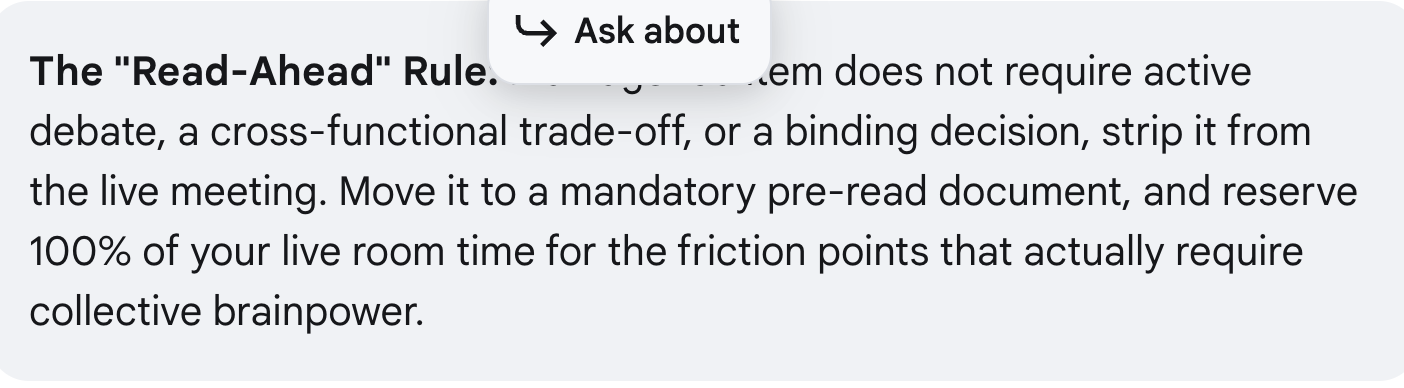
You don't need to cancel your leadership meetings to stop paying the Meeting Tax—you just need to redesign how the room is used. Before your next executive session, apply this simple filter to every item on the agenda: